
nesteye

Measure continuously. Validate carefully.

nesteye combines computer vision, environmental sensing, and edge inference to turn barn activity into practical operating signals.

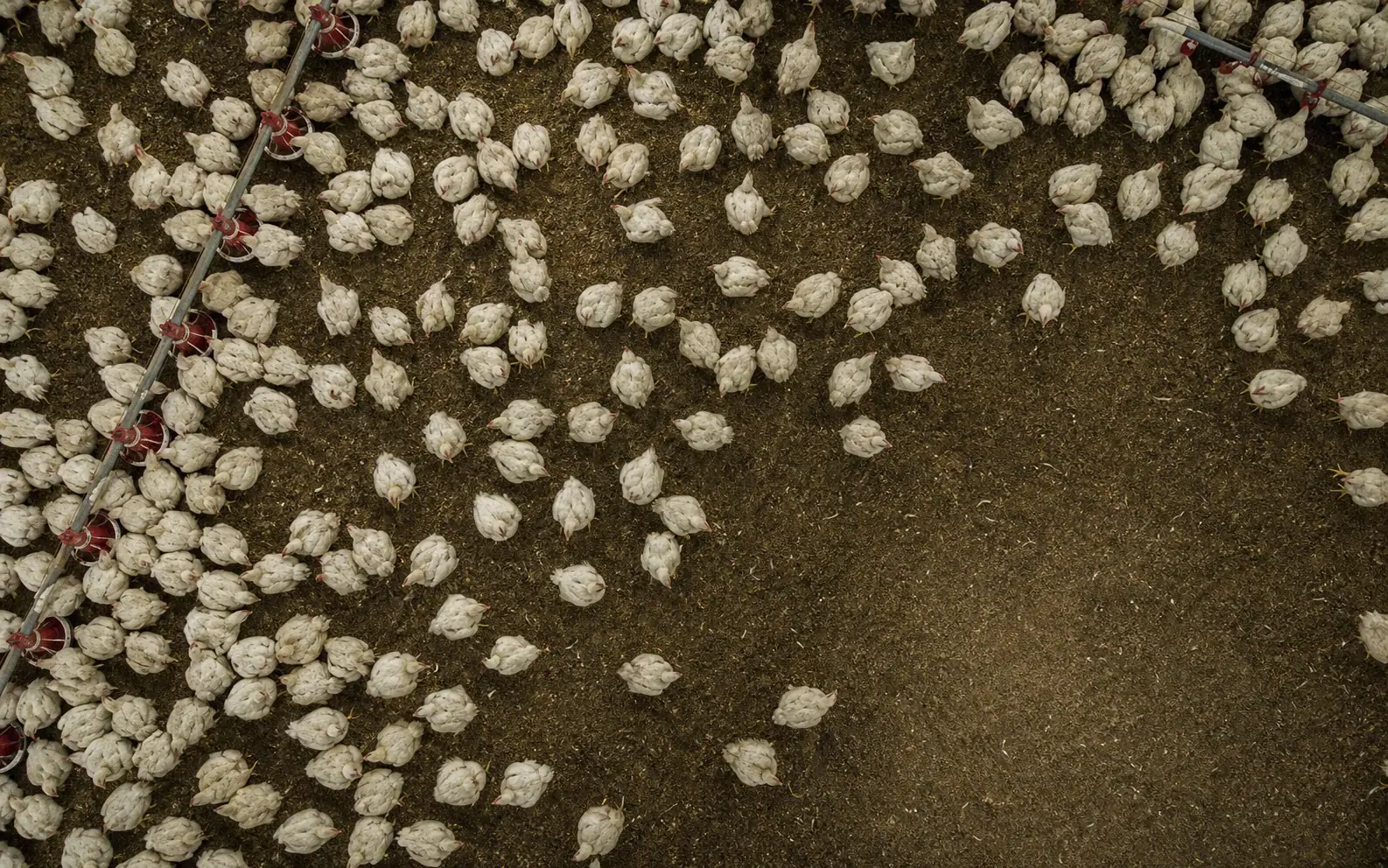
Overhead poultry flock view representative of nesteye camera placement

Fast enough to matter. Specific enough to test.

The goal is not to show operators more data. It is to identify a meaningful change, preserve its context, and make the result measurable.

Understand the pattern, not one crowded frame.

nesteye evaluates flock movement across time. Repeated-frame confirmation helps separate a developing pile from normal clustering, changing light, dust, and the visual complexity of a working barn.

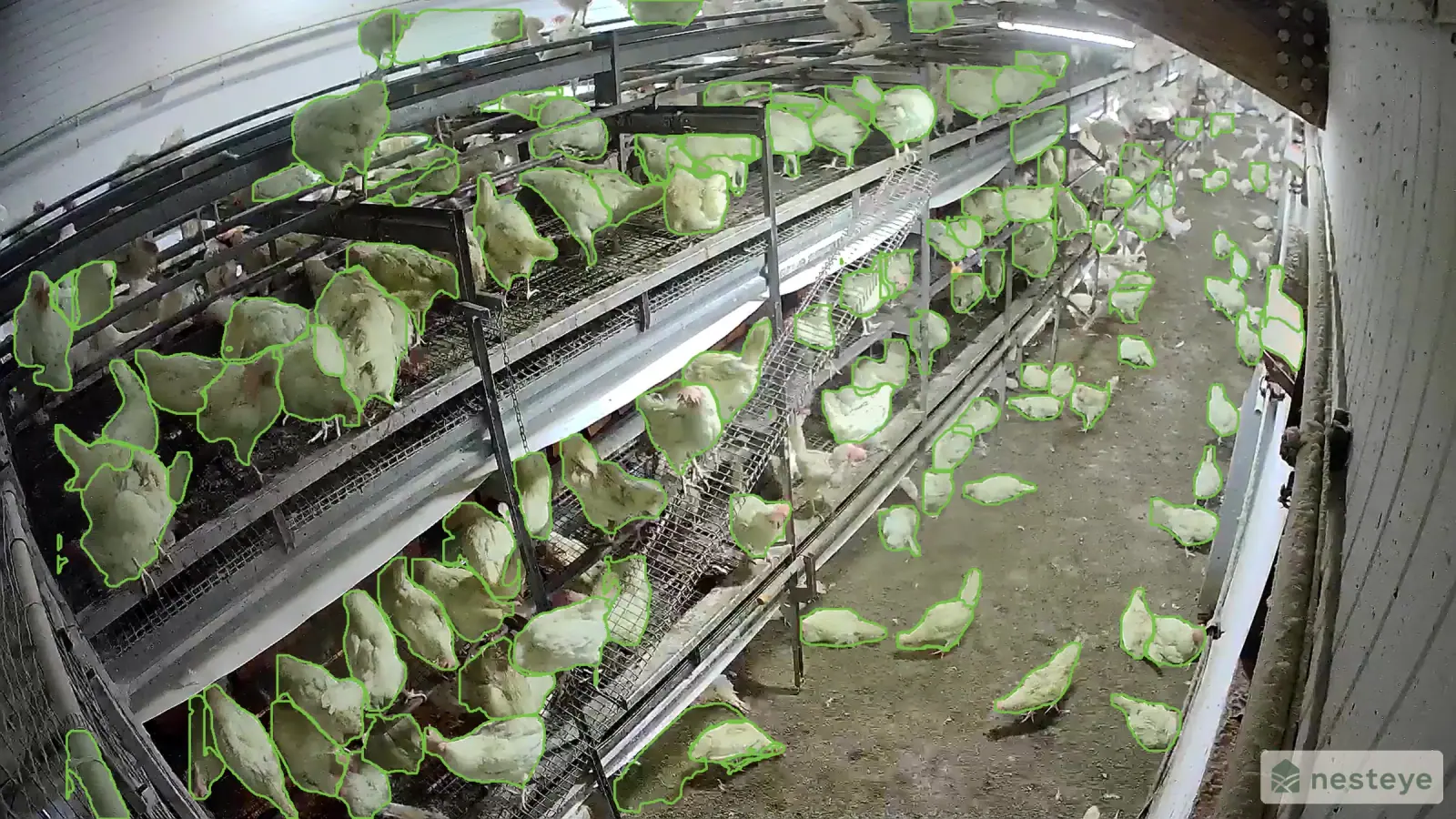
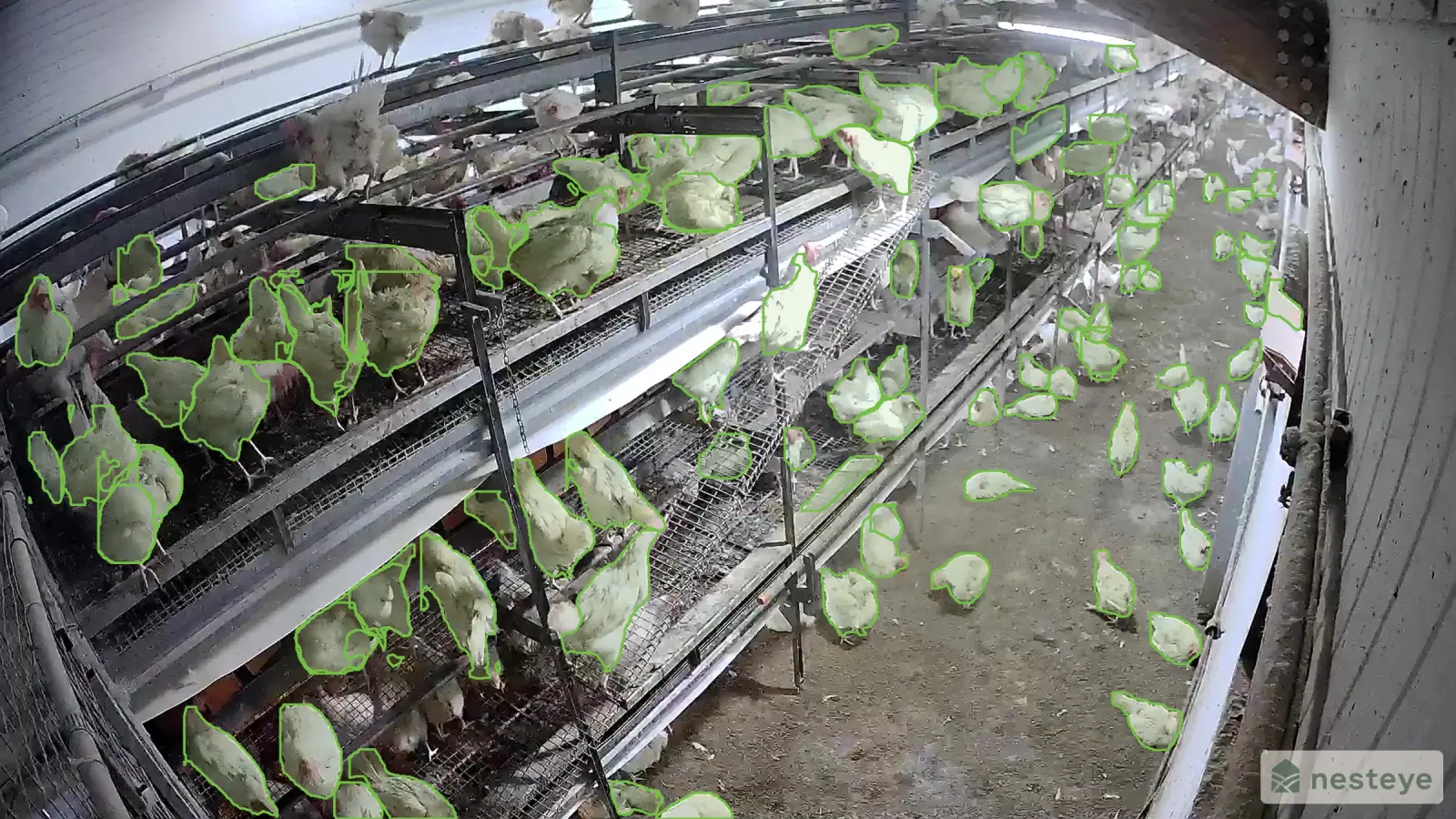
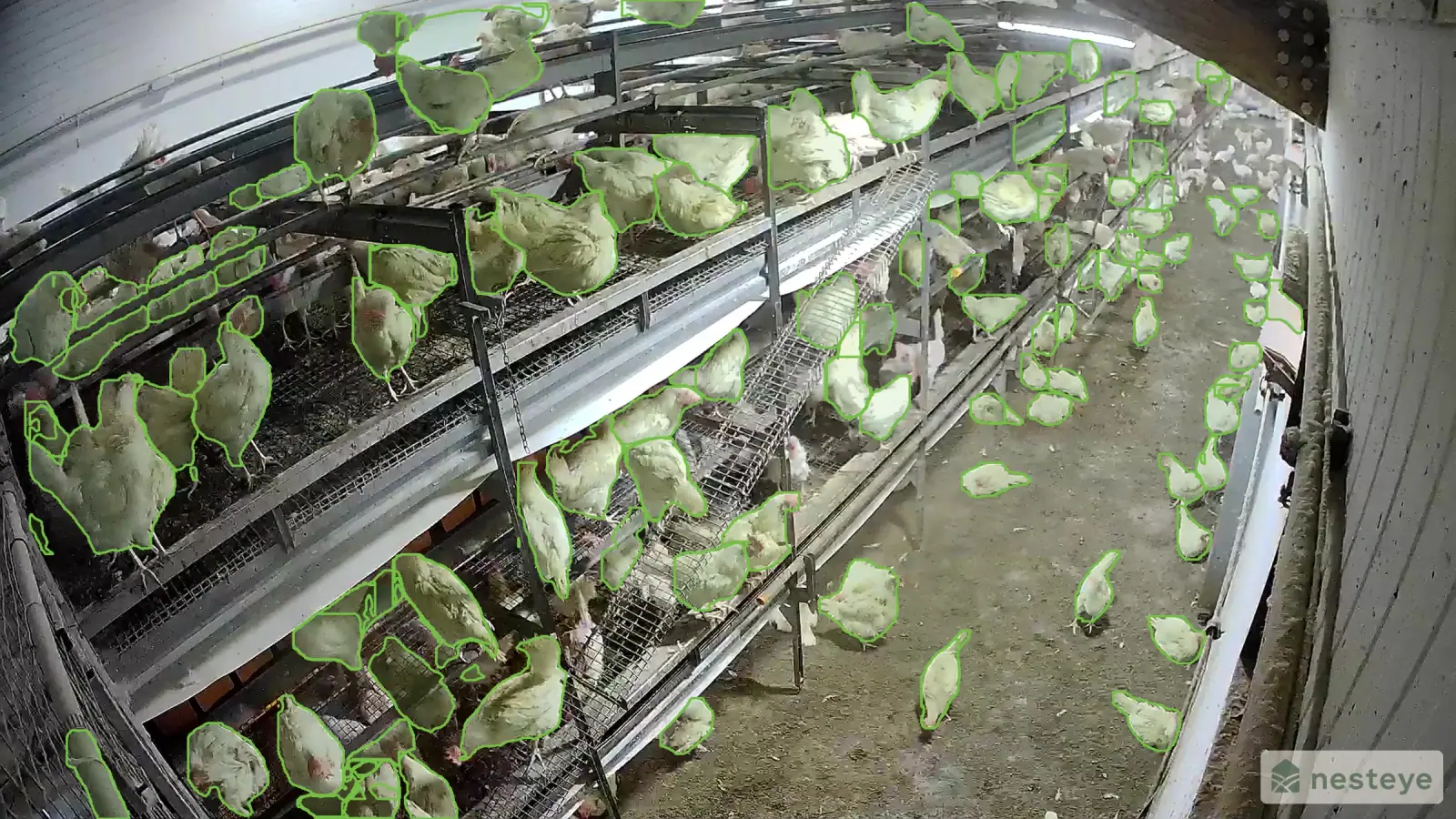
Live camera frame from a commercial poultry house with each bird outlined by the segmentation model
Frame 1 from the same camera
Frame 30 from the same camera
Frame 90 from the same camera
Frame 120 from the same camera
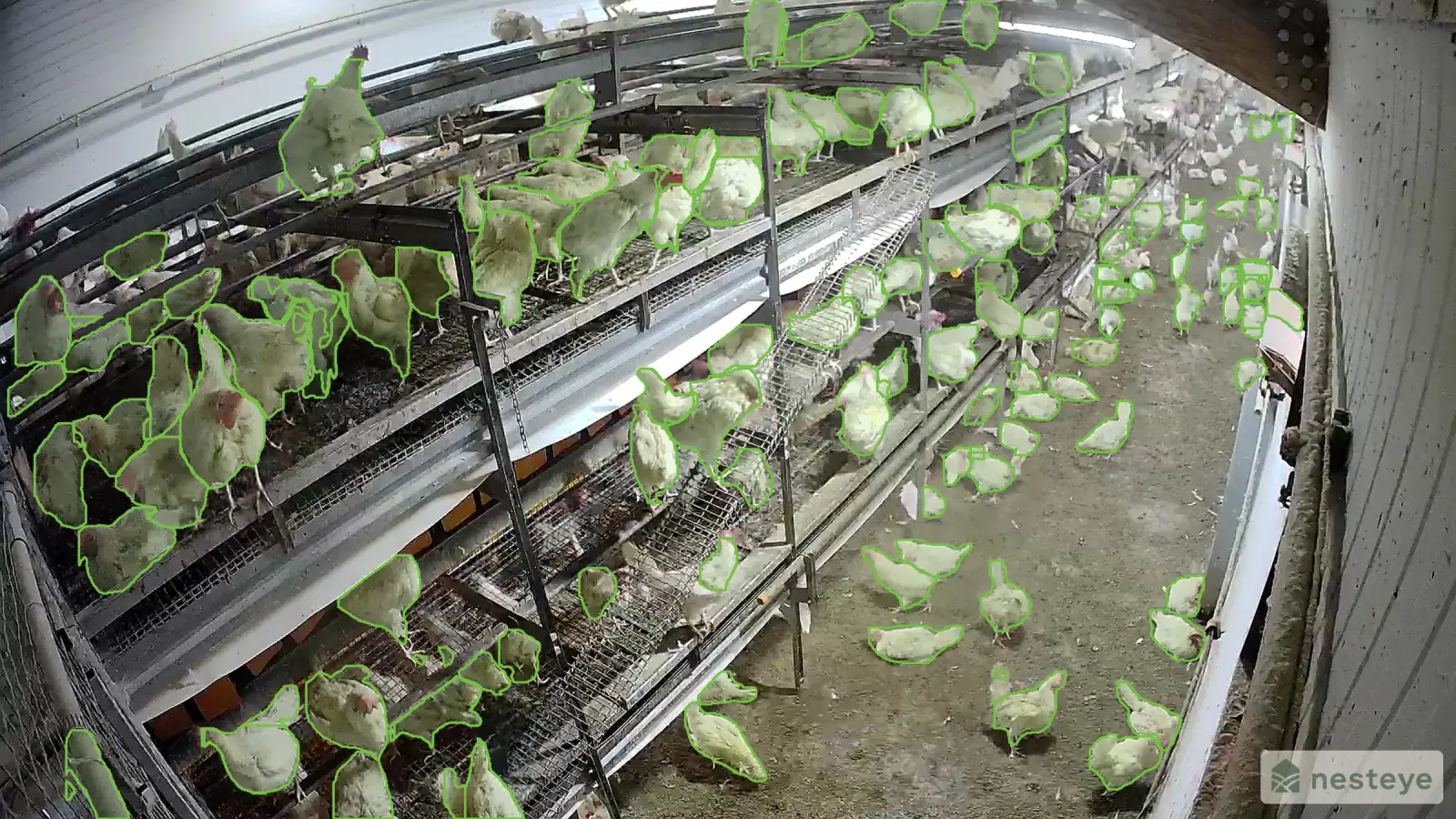
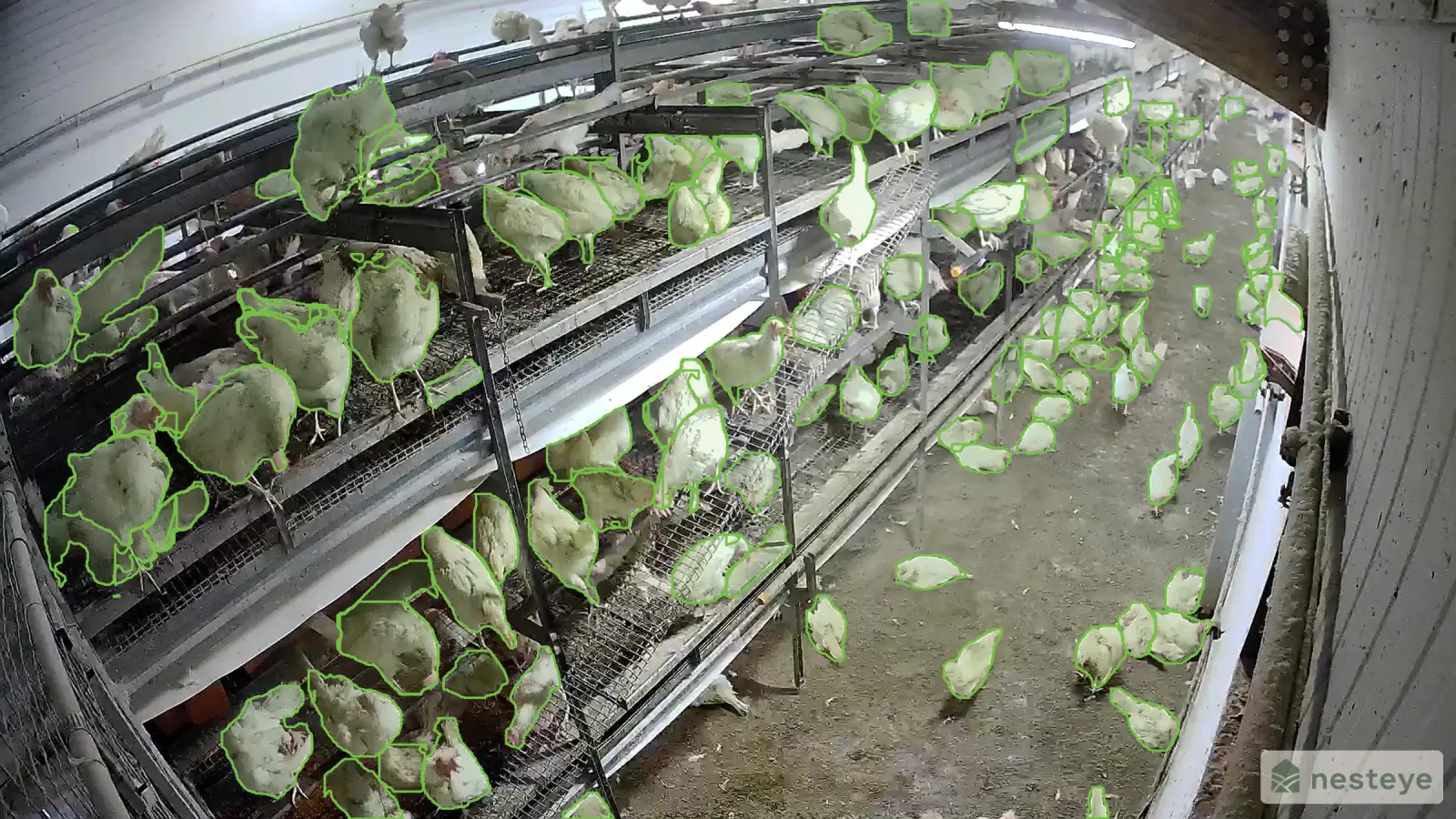
Five frames from one live camera, 30 frames apart. Every bird is segmented in each frame, so movement between frames is what the system reasons about.

How each signal is measured.

Five consecutive camera frames. A cluster appears in the second frame and persists through the fifth, so it counts as an event.frame 1frame 2frame 3frame 4frame 5persists for three frames, so it counts
A cluster is only an event once it has held across several frames.
A bird seen from above with its length, width and area measured. Those three measurements feed a per-bird weight estimate.lengthwidthhatched areaweight estimateper bird, every daylength, width,area
Length, width and area from the overhead view become a daily weight estimate for each bird.
  • Repeated-frame confirmation

    A developing cluster must persist across multiple frames before the system treats it as a confirmed event, reducing reactions to ordinary movement.

  • Overhead morphometrics

    Vision-derived body measurements support daily weight and uniformity estimates across more of the flock than a small manual sample.

  • Synchronized barn signals

    Environmental readings sit on the same timeline as flock behavior so operators can investigate the conditions surrounding a change.

  • Disease, mortality, and gait signals

    Current disease signals are reviewed with flock behavior and barn context so operators can investigate and respond sooner.

Results need boundaries.

Piling detection scored 0.998 average precision on held-out test data. That is a test result, not a guarantee of performance in every barn. Layout, installation, lighting, dust, flock behavior, and operating conditions can affect results, and pilot planning establishes the correct baseline for each operation.

Disease, mortality, and gait monitoring are current nesteye capabilities. Their signals appear with barn context for operator review, while commercial onboarding establishes barn-specific baselines and validates performance for each operation.

A feces-based risk model on the existing camera and edge system.

nesteye's feces-based Salmonella model flags visual changes for operator review on the existing camera and edge system. Supporting 2024 research found broiler activity can carry an early infection signal.

The model works as an operator-review signal. It is not a laboratory replacement and does not establish a diagnostic claim.

Source: Poultry Science Association Annual Meeting abstract

The research behind what we measure.

nesteye translates peer-reviewed poultry research into testable barn methods. Published studies guide the architecture; pilot data determines what the product can responsibly claim.

Temporal behavior

Movement becomes evidence over time.

Published work in commercial broiler houses shows that trajectories can be grouped into distinct activity patterns. Our research direction builds on the same principle: persistence, density, and motion change carry more meaning together than any isolated frame.

Read literature reviewCampbell et al., 2024

Daily weight visibility

Geometry first. Estimation second.

Depth-based broiler research combines instance segmentation, physical shape features, and learned features before regression. That informs a careful path toward daily flock weight and uniformity estimates without relying on a few convenient birds.

Piling intelligence

A pile is a sequence, not a shape.

Automatic piling research compares temporal and convolutional models because dense clustering develops across video, not in a single still. nesteye uses repeated-frame confirmation to distinguish a developing event from ordinary flock movement.

Read literature reviewJensen et al., 2025

Define the barn, the baseline, and the result.

Discuss a pilot