
One edge system. A growing model library.
Cameras, sensors, local AI, and barn-level intervention work together today, while the same installed frame creates a path to new monitoring models.
Built around the barn, not the cloud.
Decisions stay inside the barn. Only status, trends, and alerts need to leave it.
- Overhead cameras on power-over-Ethernet keep the whole flock in view, day and night.
- Environmental sensors log temperature, humidity, and air quality on the same timeline as the birds.
- A small edge computer in the barn runs every model locally, in under half a second, so nothing time-sensitive waits on the cloud.
- Addressable lights and speakers break up a confirmed pile without waiting for a barn walk.
Five signals. One place to look.
Piling, weight, environment, disease monitoring, and the dashboard operators actually use.
Piling
Detect and disperse dangerous piling.
Overhead vision identifies developing clusters while adaptive light and sound can intervene inside the barn.
Repeated-frame confirmation helps separate a real event from ordinary flock movement before the system responds.
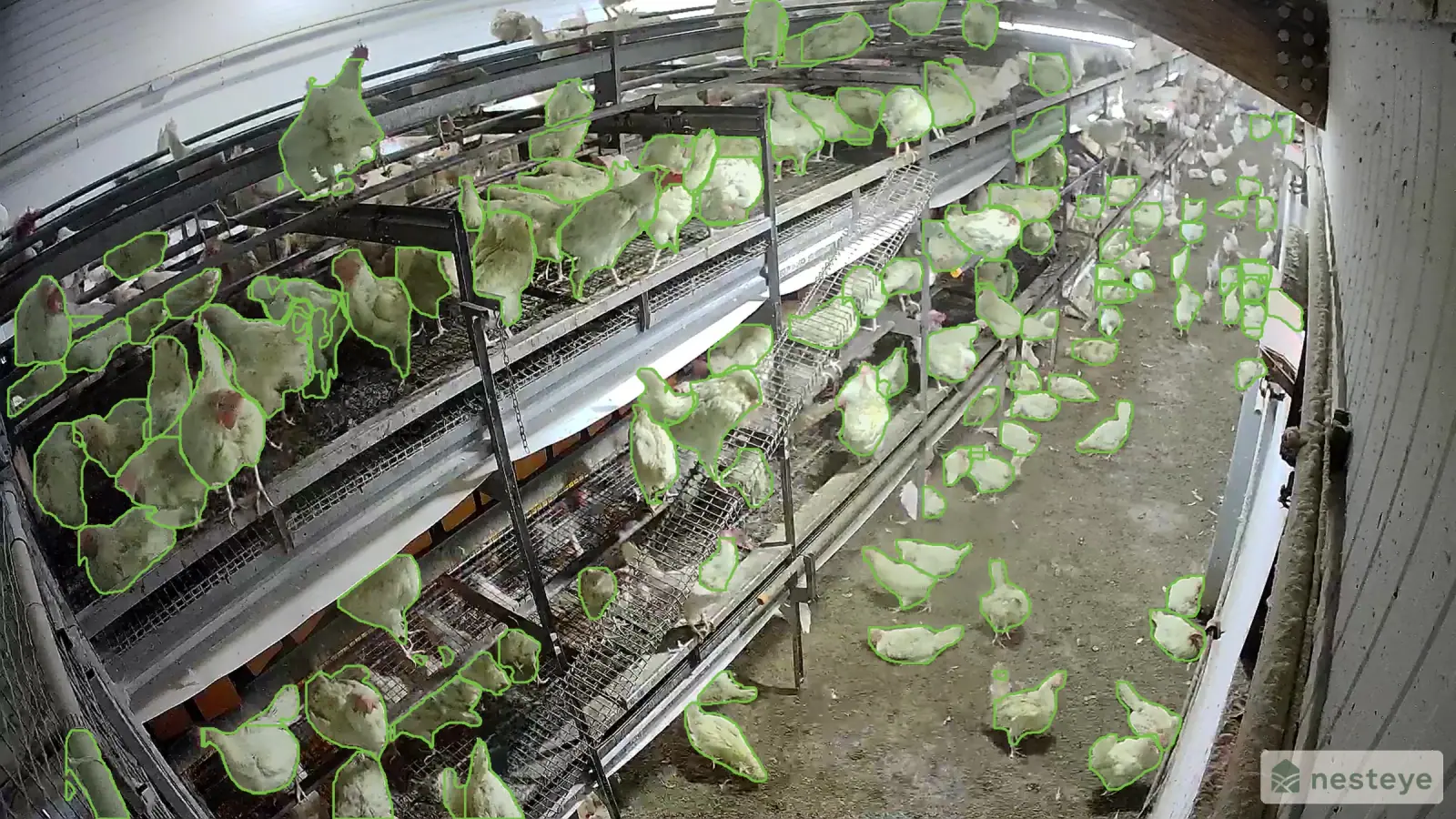
Every bird outlined, every frame.
A cluster has to persist across frames before the system intervenes.
What the system does today.
Fecal-pattern monitoring for Salmonella risk runs on the same cameras. See the research. Commercial onboarding is pilot-led and barn-specific.
Piling
Repeated-frame confirmation helps separate a real event from ordinary flock movement before the system responds.
Weight
A broader overhead view reduces reliance on stressful catches and small, biased walk-over samples.
Environment
Environmental signals stay connected to flock activity instead of living in a separate operating view.
Dashboard
Only lightweight operational data leaves the barn; time-sensitive inference stays on the edge.
Disease monitoring
Disease signals appear in the dashboard with barn context so teams can investigate and respond sooner.
Start with one measurable pilot.
Every installation begins with barn fit, operating goals, and a shared definition of success.
Survey
Review the barn layout, camera coverage, network access, power, and operating goals.
Install
Mount cameras and sensors, connect the edge computer, and calibrate the system for the house.
Pilot
Measure performance against an agreed operating baseline before broader deployment.
The practical details.
Discuss a pilotA typical nesteye system combines overhead PoE IR cameras, an environmental sensor array, an Edge SoC box, and addressable light and audio hardware for intervention.